close
This way of building is not new. The method carries the name of Charles Goodyear Jr., who built its machine in the late 19th century, but the technique itself is older. For generations it was the work of hands, a slow sequence of stitches passed down through workshops. The machine did not change the logic of the craft. It only made it repeatable.
Inside the shoe, the work continues unseen. With every wear, the cork beneath the foot compresses, slowly recording the weight and movement of its owner, until it has molded to the shape of the foot. This is why a Goodyear-welted shoe feels better the longer it is worn. There is a break-in period, and what follows is not softness in a disposable sense, but a shoe that has come to know its wearer. The repair and the molding come from the same place: a construction that assumes the shoe will be kept.
This is why it belongs on a dress shoe. A dress shoe carries two demands at once. It must hold its line, and it must live close to the body. Few objects are asked to be both formal and intimate. The Goodyear welt is what lets ours be both: structure on the outside, memory within.
The choice is also personal. A derby is part of my everyday life, worn more often than sneakers, and a shoe worn that often cannot afford to be precious. Choosing the Goodyear welt was never about borrowing a respected tradition. It was about what the method allows a shoe to become: one that ages rather than wears out, that takes on marks without losing its character, and when the sole finally gives, one worth repairing rather than replacing.
An object made with intention should also be given the means to continue. That is why we chose the Goodyear welt: partly because it is a mark of quality, mostly because it gives the shoe a reason to stay.



Dante Derby
Goodyear welt. The phrase appears wherever quality is discussed, in conversations about well-made shoes and long-lasting boots. Yet few outside the footwear world can say what it is, or why it became one of the most trusted ways to construct a shoe. At Cmmawear, every decision begins with intention. Not what something looks like, but why it is there. What, then, is the Goodyear welt? And why did it earn its place in our dress shoe?
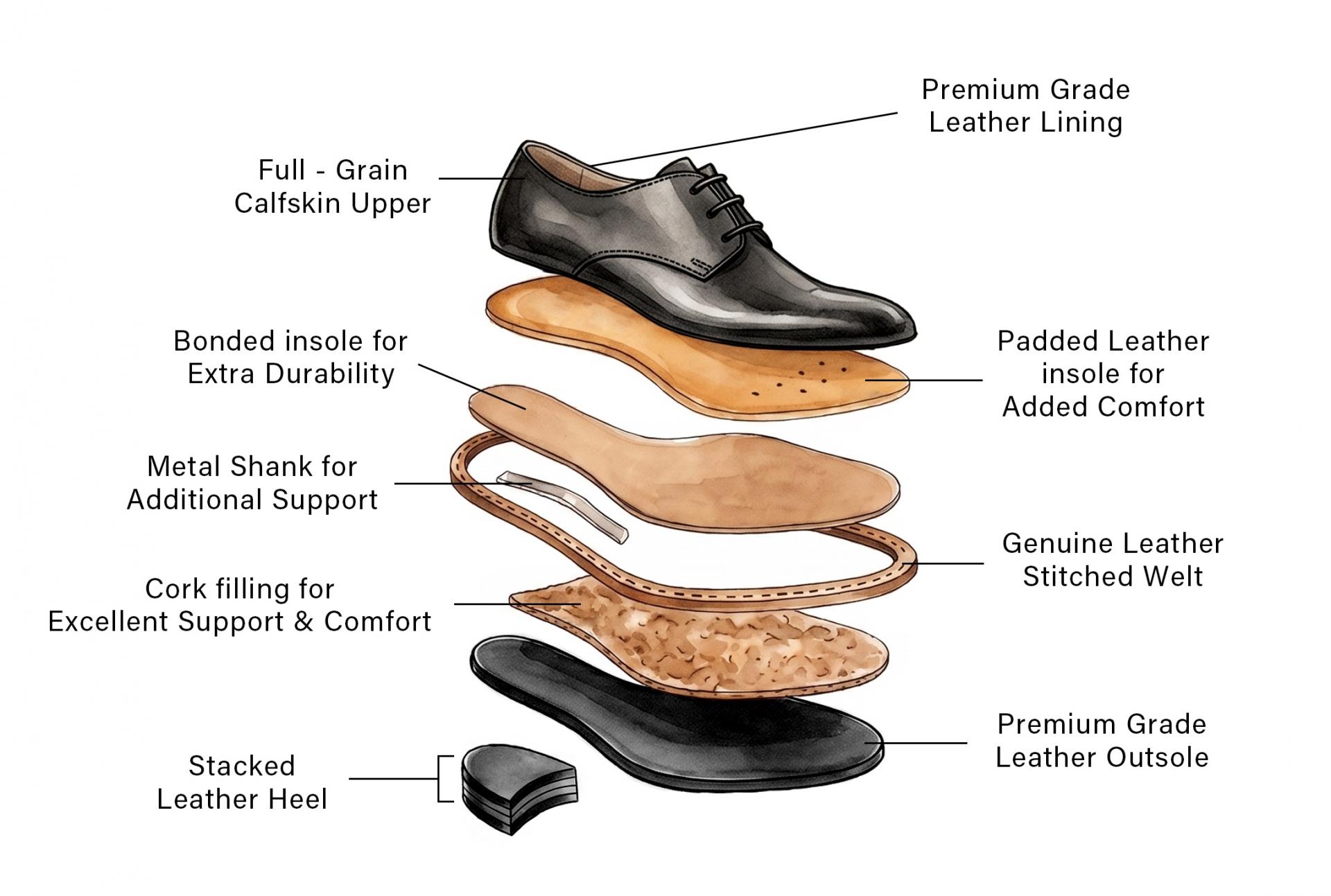
A Goodyear welt is a strip of leather that runs around the perimeter of the shoe, between the upper and the outsole. The welt is stitched to a rib on the insole, holding the upper in place between them. The cavity beneath is filled with cork, and a shank is set in to support the arch. Then the outsole is stitched to the welt. Not to the upper.
That last detail is the entire idea. Because the sole is joined only to the welt, it can be removed and replaced without disturbing anything above it. The shoe is built to be taken apart, and built again. The visible stitching along the edge of the sole is the proof: the construction itself, shown openly.
This way of building is not new. The method carries the name of Charles Goodyear Jr., who built its machine in the late 19th century, but the technique itself is older. For generations it was the work of hands, a slow sequence of stitches passed down through workshops. The machine did not change the logic of the craft. It only made it repeatable.
Inside the shoe, the work continues unseen. With every wear, the cork beneath the foot compresses, slowly recording the weight and movement of its owner, until it has molded to the shape of the foot. This is why a Goodyear-welted shoe feels better the longer it is worn. There is a break-in period, and what follows is not softness in a disposable sense, but a shoe that has come to know its wearer. The repair and the molding come from the same place: a construction that assumes the shoe will be kept.
This is why it belongs on a dress shoe. A dress shoe carries two demands at once. It must hold its line, and it must live close to the body. Few objects are asked to be both formal and intimate. The Goodyear welt is what lets ours be both: structure on the outside, memory within.
The choice is also personal. A derby is part of my everyday life, worn more often than sneakers, and a shoe worn that often cannot afford to be precious. Choosing the Goodyear welt was never about borrowing a respected tradition. It was about what the method allows a shoe to become: one that ages rather than wears out, that takes on marks without losing its character, and when the sole finally gives, one worth repairing rather than replacing.
An object made with intention should also be given the means to continue. That is why we chose the Goodyear welt: partly because it is a mark of quality, mostly because it gives the shoe a reason to stay.